
2020

From the 1st to the 12th of September 2026, I completed a short-term research internship at the Faculty of Veterinary Medicine of the Lithuanian University of Health Sciences in Kaunas, Lithuania. My research internship supervisor was Prof. Dr Paulius Matusevičius.
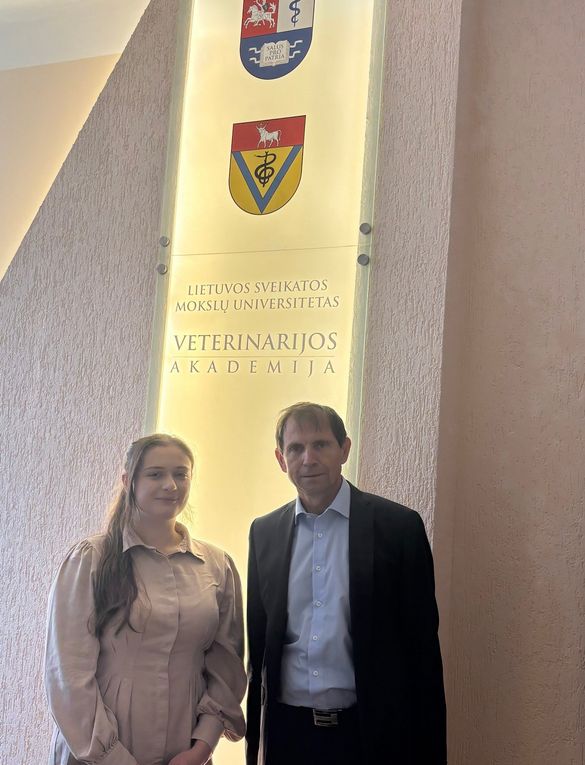
My stay at the Faculty of Veterinary Medicine provided an excellent opportunity to learn about the structure and functioning of the Faculty. During my visit, I held numerous meetings with academic staff members. These meetings provided an opportunity to exchange knowledge and experience and gave me a better understanding of the teaching and research activities carried out at the Faculty. The hosts also gave me a tour of the university campus and presented its extensive educational facilities.
Among other facilities, I visited the student library, where the Biosphera programme is available as a modern tool for interactive learning of animal anatomy.
I also had the opportunity to visit the exhibition hall. Its exhibits provide valuable support for teaching and facilitate the acquisition of knowledge concerning the anatomy of various animal species.
In addition, I visited the lecture rooms and the Simulation Centre, where veterinary students can develop and improve their practical skills in conditions resembling real-life situations.
Another important part of my visit was a tour of the Museum of the Veterinary Academy, which constitutes an important part of the university’s heritage. Another important aspect of my stay was learning about the research projects currently being carried out at the Faculty. I also became familiar with the principles governing the operation and organisation of work within a Lithuanian research institution. The knowledge I gained allowed me to gain a broader perspective on the organisation of research and education in the field of veterinary medicine.
A particularly valuable part of my stay was the opportunity to learn about the activities of the accredited laboratory UAB “Pieno tyrimai”. It is a central laboratory responsible for assessing the composition and quality of milk collected throughout Lithuania. The laboratory also identifies the etiological agents responsible for mastitis and determines their antimicrobial susceptibility. In addition, it performs pregnancy diagnosis in cows based on milk sample analysis and conducts feed analysis.
The laboratory operates a standardised system for the collection, identification and preservation of milk samples. Its activities are supported by a Laboratory Information Management System (LIMS), which covers the delivery and testing of samples, information management, the transmission of information, analysis of results, as well as their grouping and statistical processing. The system is also used to manage the quality assurance system and to monitor and control raw milk.
The time spent at this laboratory significantly expanded my knowledge of modern techniques for the identification of microorganisms. I also gained a better understanding of the principles of proper analysis and interpretation of laboratory test results. Furthermore, I became familiar with the methodological standards and research procedures applied in an accredited laboratory. This experience will certainly be valuable in my future scientific work. During my visit, I also had the opportunity to present the research plan for my doctoral dissertation and actively participate in the discussion that followed. It was an excellent opportunity to exchange knowledge and experience with the researchers.
In addition to its scientific dimension, my research internship in Lithuania allowed me to learn more about the history, culture, historical monuments, cuisine and traditions of the country. During my stay, I had the opportunity to admire both the historic Old Town and the more modern parts of Kaunas. These two aspects of the city illustrate how its historical heritage coexists with modernity.
Kaunas impressed me not only with its distinctive architecture but also with its people. As an important academic centre, the city attracts many students. Both students and permanent residents proved to be exceptionally open, hospitable and helpful. Thanks to their kindness, I quickly adapted to my new surroundings, and I look back on my time in Kaunas with great fondness.
In conclusion, participation in the research internship contributed significantly to broadening my scientific knowledge, particularly in the field of microbiological diagnostics. It also allowed me to gain insight into the functioning and organisation of a foreign research institution and to improve my scientific communication skills in English. The scientific contacts established during the internship were equally valuable. I hope that they will lead to further academic cooperation in the future. All these experiences, together with the opportunity to learn about the culture and traditions of Lithuania, made the internship an extremely valuable professional and personal experience.
The internship was carried out within the framework of the NAWA PROM Project – Short-Term Academic Exchange, internal project no. NAWA.RNM.25.263, at the University of Life Sciences in Lublin.
MSc Joanna Kowalik


13 Akademicka Street, 20-950 Lublin
VATIN 712 010 37 75
REGON no. 000001896
ePUAP: /UP-Lublin/SkrytkaESP
